
By: Tunji Okunlola
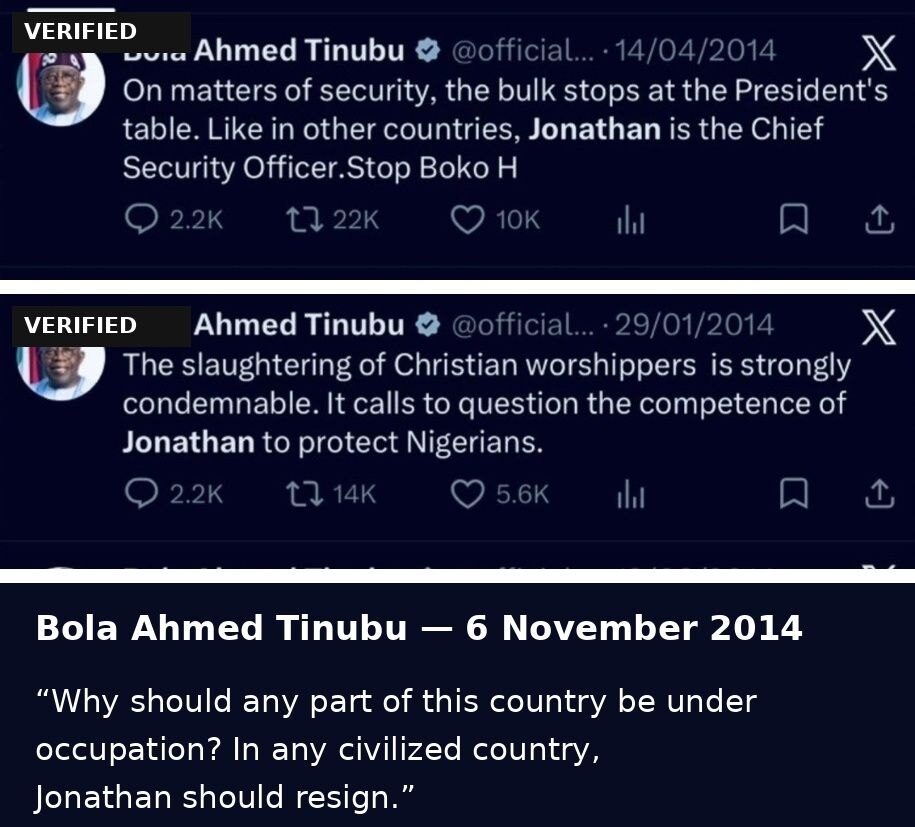
Chief Femi Fani-Kayode’s open letter attacks Atiku Abubakar chiefly for calling President Tinubu “Bola” instead of “President.” A set of 2014 posts attributed to the then APC leader Bola Tinubu shows him referring to then-President Goodluck Jonathan without any title, which undercuts the moral force of the complaint. But there is a difference in how the two men named their targets, and nothing in Nigerian law that I could find makes Atiku’s choice of words unconstitutional.
The letter and its argument
In a letter signed FFK, Fani-Kayode says he listened to Atiku’s October 1 address and found it calm and well delivered, but dishonest and disrespectful. His central grievance is that Atiku repeatedly used the President’s first name. He leans on a quoted passage attributed to Akin Osuntokun, a former adviser to Olusegun Obasanjo and ex-director-general of Peter Obi’s 2023 campaign. Osuntokun is quoted as accepting sharp criticism of a president but calling the first-name usage needless disrespect, and as asking how it would sound to call a sitting president “Segun” or “Muhammadu.”
The rest of the letter is a long list of allegations against Atiku: that he betrayed Obasanjo, belittled Goodluck Jonathan and Vice President Shettima, was called unelectable by his own running mate, and mishandled his response to the 2022 killing of Deborah Samuel in Sokoto. These are Fani-Kayode’s claims. Notably, the letter itself compares Atiku to a pit bull and a hungry wolf, language that sits uneasily with its plea for decorum.
Reports suggest the complaint is a shared line in the President’s camp. Aviation Minister Festus Keyamo and presidential aide Sunday Dare each criticised Atiku for the same thing after a press conference in Abuja, with Dare calling it the height of insolence.
What the 2014 screenshot shows
The screenshot shows six posts from an account named Bola Ahmed Tinubu, dated between January and November 2014, when Jonathan was the sitting president, and Tinubu was a leading opposition figure. Each post criticises the government and names “Jonathan” with no title. One says Jonathan has failed on security, another questions his competence, one says he should resign, and another describes him as pretending not to notice the “rape of the judiciary.” In the same posts, Tinubu does sometimes refer to the office, for instance by calling the President the Chief Security Officer, but the person is still named bare.
A bit of difference between the way name-calling played out in 2014 and now is that “Jonathan” is the former president’s surname, whereas “Bola” is Tinubu’s first name. Fani-Kayode and Osuntokun both stress the familiarity of a first name, so a defender of Tinubu could argue the cases differ. The common element is the omission of the title “President” while attacking a sitting head of state, which is the exact conduct Fani-Kayode’s letter condemns.
Even with the caveats, the parallel is real. A person who demands that critics always use the title for a sitting president would, by the same standard, have to fault Tinubu’s own posts about Jonathan.
A point for Mr. Fani-Kayode
If decorum toward the occupant of the office is the principle, it should apply to whoever is in opposition. In 2014, the man Fani-Kayode now defends criticised a sitting president, often by bare name and in sharp terms. That does not make Atiku’s choice admirable, but it does suggest the objection is about who is speaking and not about a rule both sides observe. A fair version of the letter would acknowledge that political opposition in Nigeria, including by the current President, has not been conducted in reverential language.
Did Atiku break the constitution?
I haven’t found any provision in the 1999 Constitution, or any other law, that requires citizens to address the President by title or forbids using a first name. To the best of my knowledge, the Constitution regulates the office’s powers and processes, not forms of address, and I believe Section 39 protects freedom of expression. Calling the President “Bola” is a breach of etiquette at most, and that is the way Keyamo and Dare themselves framed it, as discourteous and insolent, not unlawful.
The question to put to one is whether any statute, such as defamation or public-order law, could apply; a first name alone, with no false statement of fact, would not seem to meet that bar.
Bottom line
The criticism of Atiku is a matter of manners, not law. The 2014 posts show that Tinubu also criticised a sitting president without his title, which weakens Fani-Kayode’s appeal to a universal standard. However, the surname-versus-first-name difference gives his side a limited reply.
Sources: the text of Chief Fani-Kayode’s letter as supplied; screenshot of 2014 posts by Mr. Bola Tinubu; a search for constitutional or legal rules on forms of address returned nothing relevant. Details may have changed since publication.