
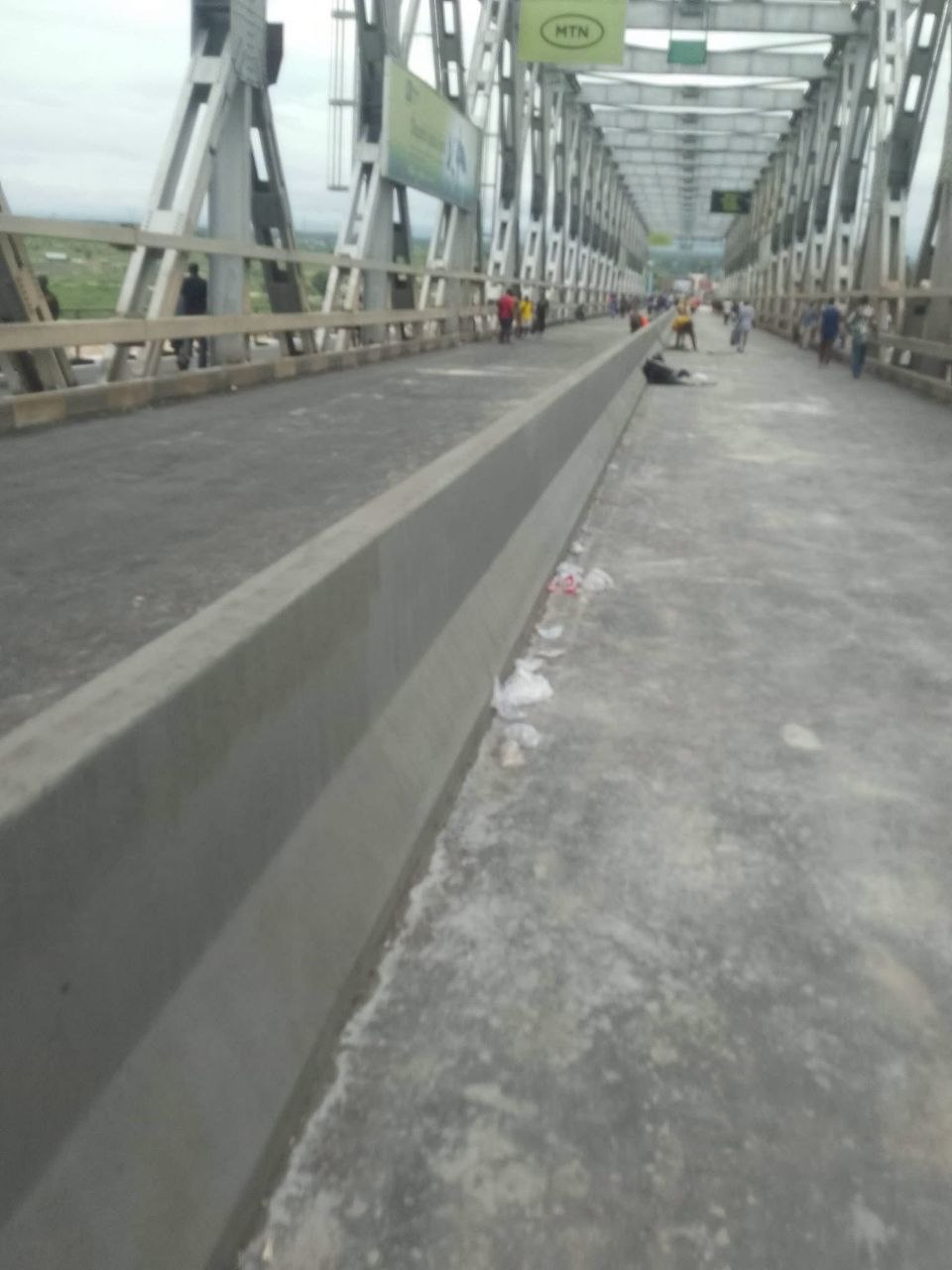
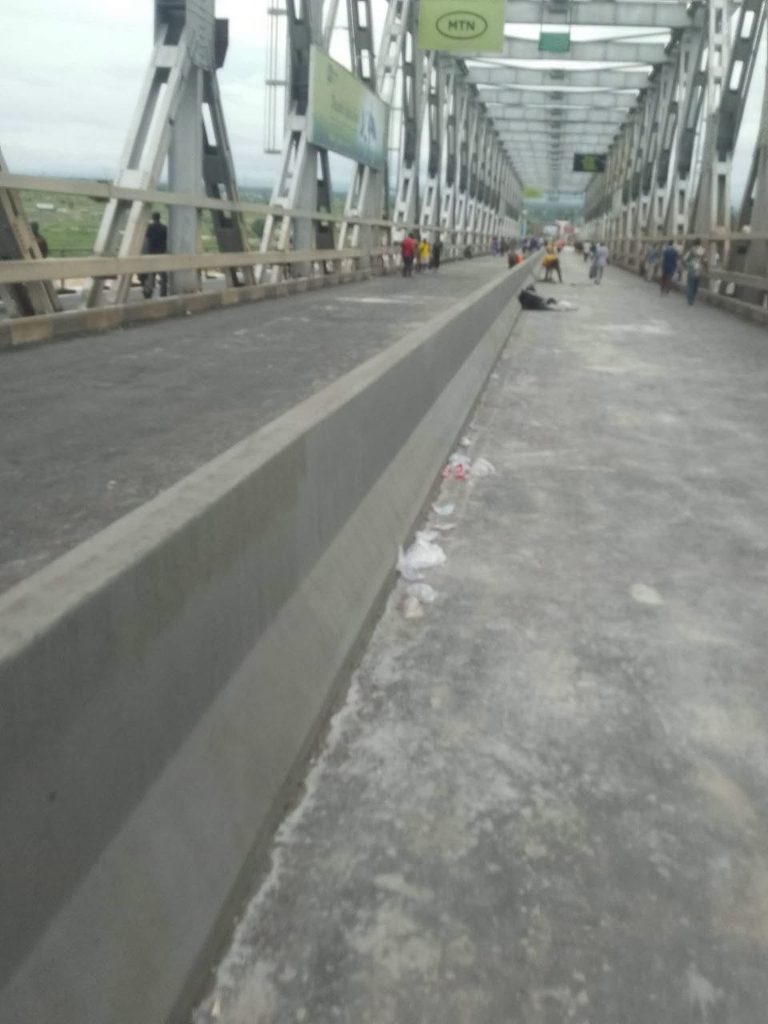
The recent installation of a concrete median on the First Niger Bridge, between Onitsha and Asaba, has understandably attracted attention. At first glance, physically separating traffic travelling in opposite directions looks like a sensible road-safety measure. But when the bridge is considered as an ageing steel structure not merely as a stretch of road; some important engineering questions deserve answers.
The First Niger Bridge was completed in 1965. Its original design provided a 36-foot (roughly 11-metre) carriageway, with pedestrian walkways on both sides. The bridge itself is approximately 1,404 metres long.
The photograph accompanying this article shows a substantial concrete median now running along the centre of the carriageway, physically separating the two directions of traffic.
The principle is sound
There’s a straightforward safety argument for the intervention. A physical median can stop vehicles travelling in opposite directions from crossing into each other’s path. Unlike a painted centre line, a concrete barrier provides real physical separation, and so can reduce the risk of head-on collisions caused by dangerous overtaking, loss of control, or driver error. On a heavily trafficked bridge, that’s not a small benefit.
But good traffic engineering isn’t just about placing a barrier between opposing vehicles, the entire cross-section of the bridge has to work as an integrated system.
That’s where the questions begin.
How much usable width is actually left?
The bridge was originally designed with a 36-foot carriageway. Once a substantial concrete median is introduced, the critical question becomes: what are the actual widths of the two traffic lanes once the median, edge clearances, and other restrictions are accounted for?
That measurement should be public. It isn’t enough to cite the original ~11-metre carriageway. Engineers need to establish the effective usable width after modification and demonstrate that it meets applicable road-design standards. A bridge that looks wide enough in a photograph can have considerably less usable width once structural members, barriers, drainage, pedestrian facilities, and vehicle clearances are factored in.
Then there’s the pedestrian question
The new median separates vehicles from oncoming vehicles but it raises questions about separation between vehicles and pedestrians. If these areas are meant to function as walkways, they should be clearly defined, continuous, and adequately protected particularly on a bridge carrying heavy vehicle traffic. A modern approach to bridge safety shouldn’t solve one collision risk while leaving another group of road users exposed.
The bridge itself must also be considered
The First Niger Bridge is not a newly built concrete highway bridge, it’s an approximately 61-year-old steel truss structure. That doesn’t make it inherently unsafe; age alone isn’t a measure of structural integrity. But modifications to an existing bridge should be backed by proper structural assessment.
A permanent concrete median adds dead load and creates a structure that can be subject to vehicle impact. Engineers need to have considered, among other things:
- the additional dead load and how it transfers to the existing deck
- vehicle impact forces
- the condition and capacity of the existing deck
- drainage
- expansion and contraction
- maintenance access
- emergency access
These aren’t arguments against the median but questions that should be answered by the engineering documentation supporting it.
The right question isn’t “does the barrier look good?” It’s: was the new traffic arrangement designed and independently assessed as part of the bridge’s overall structural and road-safety system?
If the answer is yes, the relevant authorities should have little difficulty publishing the basic design parameters:
- What is the width of each traffic lane?
- How wide is the concrete median?
- What lateral clearance exists between vehicles and the bridge structure?
- What provision has been made for pedestrians?
- What additional load does the median place on the bridge?
- What vehicle-impact standard was used for the barrier?
- Was the bridge’s load rating reassessed after the modification?
These are reasonable questions for infrastructure carrying enormous volumes of people and goods between two major parts of Nigeria.
The bridge’s role has also changed
The First Niger Bridge was designed for 1960s traffic conditions. Population, vehicle ownership, freight movement, and commercial activity around Onitsha and Asaba have grown dramatically since then. That makes it important that interventions on the old bridge be treated as risk management and preservation of existing infrastructure not as a substitute for long-term transport planning.
A reasonable engineering position
Based on the photograph and the documented dimensions of the bridge, I wouldn’t argue that the concrete median is inherently a bad idea. Physical separation of opposing traffic is a well-established road-safety principle.
But neither would it be responsible to call the modification an engineering success simply because it separates traffic. The real issue is whether the entire arrangement-lane widths, median, pedestrian facilities, clearances, structural loading, barriers, and emergency access has been properly engineered for this particular bridge.
The First Niger Bridge is too important, and too old, for its modifications to be judged on appearance alone. What Nigerians deserve is transparency about the engineering behind the intervention. If the authorities publish the lane dimensions, median specifications, structural assessment, and safety rationale, the public can judge the intervention on evidence rather than photographs and speculation.
The goal shouldn’t just be to keep traffic moving on the First Niger Bridge. It should be to keep it moving safely while preserving the structural integrity of one of Nigeria’s most important transport links.
Opinion | ClarityNewsNG
Discover more from CLARITYNEWSNG
Subscribe to get the latest posts sent to your email.