By: Ganiyu Olayinka
The cross-party alliance being championed by the Minister of the Federal Capital Territory, Nyesom Wike, under the banner of the “Rainbow Coalition” has opened a new front against governors elected on the All Progressives Congress platform, throwing into question who will control the political machinery behind President Bola Ahmed Tinubu’s 2027 re-election bid.
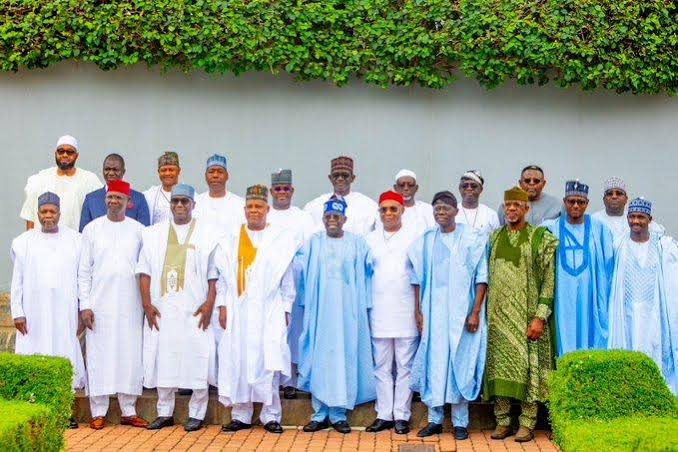
The Progressive Governors’ Forum has publicly separated itself from the arrangement, stating that its members will not back any political configuration that could undercut the President’s re-election, erode the party or damage APC candidates at any level. The position was set out in a communique read by the forum’s chairman, Imo State Governor Hope Uzodimma, after a closed-door meeting in Abuja.
What began as friction between Wike and a handful of APC governors has widened into a broader argument about how Tinubu’s campaign, the APC’s formal structure and Wike’s cross-party network should relate to one another.
Wike disputes the charge that his coalition is aimed at the APC or its governors. In his most recent response, issued through his spokesman, he described his backing for the President’s re-election as sacrosanct while maintaining that the Peoples Democratic Party remains at liberty to contest other offices. The coalition, he said, has nothing to do with the APC.
That formulation lays bare the contradiction at the centre of the alliance. Wike and those around him want politicians of every stripe to rally behind Tinubu; the governors counter that their own mandate must also include keeping the ruling party alive and its candidates in office.
Their worry is straightforward: politicians could vote for Tinubu at the top of the ballot while backing rival parties for governorship and legislative seats. The result would be split-ticket voting that leaves APC candidates exposed even as the President gains. The risk is sharpened by the fact that the presidential and National Assembly polls fall on the same day. Party members have also raised the possibility that voters in rural areas may struggle to tell competing symbols and candidates apart when local leaders are urging them to support different parties at once.
For Wike, that permeability is the point. Instead of demanding defections to the APC, the coalition lets politicians keep their existing platforms while pursuing a shared presidential goal. He has framed it as a way of assembling actors whose state-level interests may diverge but who are united behind Tinubu.
The approach would hand the President reach into structures the APC does not control, especially in states where opposition figures command durable grassroots followings. It also raises the prospect of a parallel machine running alongside the party, which appears to be what unsettles the governors.
For them, 2027 is about far more than the presidency. They have state structures to defend, legislative allies to secure, succession questions to settle and party candidates to elect. An alliance that lifts Tinubu while promoting non-APC contenders could aid the President and weaken the governors and their party at the same time.
The strain is already showing on the ground. Wike has clashed openly with Kwara’s Governor AbdulRahman AbdulRazaq, while figures linked to the coalition manoeuvre against APC interests there. In Rivers, the proposed governorship arrangement and the choice of candidates have proved contentious. Cross River is shaping up as a third battleground drawing in politicians from several parties.
Rivers illustrates the tangle most clearly. Wike remains a PDP member while fronting a coalition that takes in politicians from other parties, the APC among them. Governor Siminalayi Fubara, meanwhile, has aligned himself with Tinubu and the coalition following his protracted feud with Wike. Whether such alliances hold once coalition and party interests diverge is an open question.
For Tinubu, the arrangement carries opportunity and hazard in equal measure. It could extend his base well past the APC and give opposition heavyweights a route to campaign for him. But should it antagonise the governors or entrench rival structures, it may corrode the very apparatus he depends on to turn out votes nationally.
That leaves the presidency with a delicate balancing act. Tinubu needs Wike’s network; he also needs governors who command much of the APC’s state-level organisation.
The contest, then, is not really about whether Wike supports the President. It is about how that support gets organised and who ends up controlling the structures that deliver it. An accommodation would make the Rainbow Coalition an extra pillar of the 2027 campaign. A breakdown could leave Tinubu in the unusual position of having people campaigning for him while running against his party’s candidates elsewhere on the ballot – a coalition that lifts the President while dragging on the APC.
As 2027 comes into focus, the question is whether Wike’s project settles into an outside support structure for Tinubu or hardens into a parallel machine capable of contesting the APC’s grip on the field.
Discover more from CLARITYNEWSNG
Subscribe to get the latest posts sent to your email.