
By: Ganiyu Olayinka
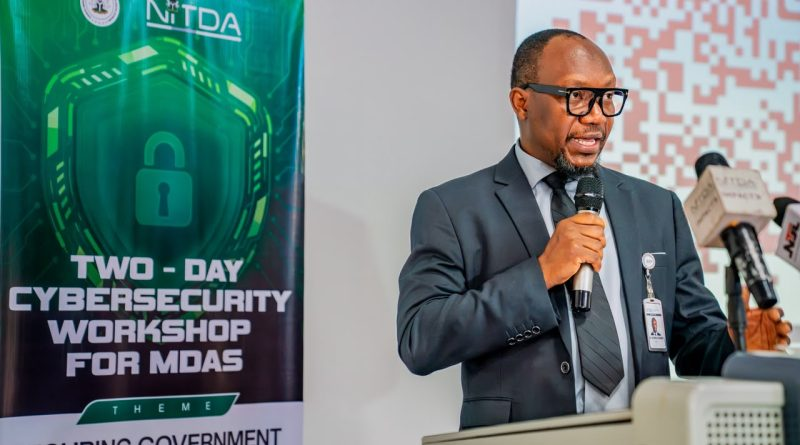
The National Information Technology Development Agency (NITDA) is pressing Ministries, Departments and Agencies (MDAs) to work more closely together to protect government digital systems, cautioning that a weak point in one agency can put others at risk.
NITDA’s Director-General, Kashifu Inuwa, raised the issue while opening a two-day Cybersecurity Workshop for MDAs in Abuja, held under the theme “Securing Government Digital Infrastructure through Capacity Building.” His remarks were delivered on his behalf by Dr Ayodele Bakare, Assistant Director in the agency’s Cybersecurity Department.
Inuwa said the timing of the workshop was significant, given how frequent, advanced and disruptive attacks on government platforms have become. He pointed to website defacements, ransomware incidents, data breaches and misuse of personal information as growing threats to public trust, service delivery and national progress. Government platforms, he noted, serve millions of Nigerians every day and have consequently become attractive targets for attackers.
He described several patterns officials have observed, including government sites being defaced or covertly rerouted to gambling platforms, ransomware incidents forcing web portals offline, and repeated intrusions into government databases resulting in stolen and misused personal data.
To underline the scale of the problem, Inuwa referred to findings from the United Nations Office on Drugs and Crime’s cybercrime assessment, which placed Nigeria among the three African countries most targeted by cybercriminals — a status linked to its fast-growing digital economy and expanding exposure to attack. He also cited estimates from a Lloyd’s cybersecurity outlook report suggesting cybercrime cost Nigeria upwards of $3 billion between 2019 and 2025.
Inuwa argued that every digital government service is effectively a promise of efficiency, transparency and access one that can only be honoured if the systems behind it are properly secured. He warned that current threats come from organised, well-resourced actors able to exploit gaps across several institutions at once, describing government cybersecurity as a shared responsibility in which the system is only as strong as its weakest link.
He reaffirmed NITDA’s role in strengthening national resilience through its Computer Emergency Response and Readiness Team, which he called the government’s first line of contact when incidents occur while stressing that prevention remains far more effective than reacting after the fact. Building real resilience, he said, depends on continuous risk assessment, sound governance, consistent policy enforcement, regular awareness training, technical safeguards, incident-response planning and long-term capacity building.
Inuwa also emphasised the human element of cybersecurity, arguing that technology alone cannot secure government systems and that trained, vigilant staff form what he called the “human firewall” – no technical control, he said, can substitute for an alert and security-conscious workforce.
He encouraged workshop participants to use the sessions to learn practically, share intelligence and work through real case studies drawn from recent attacks on public institutions. Notably, attendees will be the first external stakeholders invited to review and comment on NITDA’s draft Regulatory Guidelines for Government Information Security Management before it goes to broader consultation.
Participants were urged to speak candidly about the security challenges within their own organisations, with Inuwa suggesting that such openness could help other agencies avoid similar pitfalls.
He closed on an optimistic note, framing cybersecurity not as an obstacle to Nigeria’s digital transformation but as the foundation that will allow it to deliver greater benefits by describing the country’s digital future as an opportunity to be secured rather than a threat to be feared.
Discover more from CLARITYNEWSNG
Subscribe to get the latest posts sent to your email.