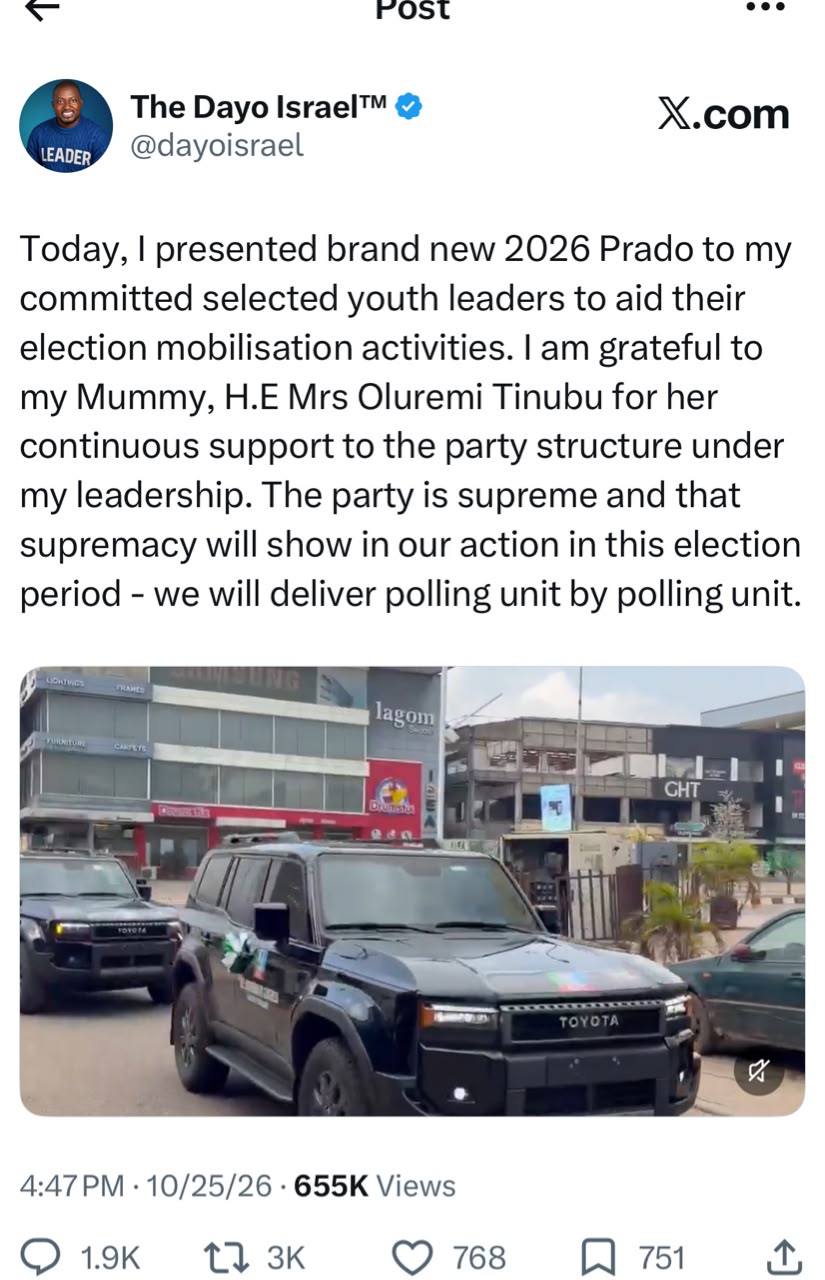
Dayo Israel, National Youth Leader of the All Progressives Congress (APC), has drawn fierce criticism after announcing the distribution of brand-new 2026 Toyota Prado SUVs to selected youth leaders for election mobilisation.
In a post on X, Israel said the vehicles would support the party’s mobilisation ahead of the 2027 elections, and he thanked First Lady Oluremi Tinubu for her support for the party structure under his leadership. “The party is supreme and that supremacy will show in our action in this election period. We will deliver polling unit by polling unit,” he wrote.
A video with the post reportedly showed 10 vehicles being presented. After widespread online backlash, both the post and the video were deleted.
The controversy is about more than the price of the vehicles. It is about judgement, and about what party leaders choose to celebrate in a country where millions are struggling with rising living costs and scarce opportunity.
A failure of situational awareness
In security practice, situational awareness means understanding your surroundings and how they should shape your decisions. Political leadership demands the same discipline.
When Nigerians are being asked to endure hardship, parading a fleet of expensive SUVs for election mobilisation suggests a leadership that has misread the public mood.
No one disputes that parties need vehicles and resources to campaign. The question is whether handing out luxury SUVs, and presenting it as an achievement, reflects sound judgement in the present climate.
For a national youth leader, the optics are especially poor. Many young Nigerians face unemployment, financial insecurity and shrinking prospects. Against that background, a conspicuous display of political spending reinforces the perception that party interests come before the welfare of ordinary citizens.
Leaders should remember that what they celebrate in public can matter as much as what they promise.
Who paid for the vehicles?
A more serious question sits beneath the optics: where did the money come from?
Were the vehicles bought with personal funds, private donations or party resources? Was any public money involved? These questions need answers backed by evidence. The announcement alone does not show that government funds were used, and making that allegation without records would be wrong.
But if public funds were involved, Nigerians would be entitled to know who authorised the spending, which budget line covered it, and whether procurement rules were followed.
Even if the vehicles were paid for entirely with private or party money, the decision to showcase them publicly still invites scrutiny. The APC leadership should clarify how the vehicles were funded and explain why they were distributed. Openness is the surest way to separate legitimate party spending from any misuse of public resources.
What does this say to young Nigerians?
The episode also raises a question about the kind of leadership being offered to the country’s youth.
As National Youth Leader, Israel holds a position meant to connect the party with the concerns and ambitions of young people. Yet giving luxury vehicles to selected party operatives does little to ease the economic difficulties of the wider youth population.
Mobilisation is a legitimate part of politics, but it should not become the main measure of youth engagement. Young Nigerians need credible policies on jobs, education, skills and economic opportunity, and the APC owes them an explanation of how its agenda will improve their lives beyond election day.
Accountability is more than damage control
Deleting the post does not answer the questions it raised. The APC leadership should address the substance of the criticism rather than treat it as a public relations setback.
The Federal Government, for its part, must show that its calls for sacrifice are matched by responsible management of public resources. Wherever public money is involved, transparency and accountability are not optional.
Ultimately, the Prado giveaway is a test of political judgement and public responsibility. Parties have every right to organise and campaign, but their leaders must reckon with the economic realities facing the people they seek to mobilise.
In a country grappling with poverty and high living costs, leadership requires more than the ability to deliver votes polling unit by polling unit. It requires sensitivity to hardship, honesty about spending and a real commitment to improving citizens’ lives.
The question Nigerians should be asking is simple: Are political leaders using their resources and influence in ways that reflect the priorities of the people they claim to represent?
Discover more from CLARITYNEWSNG
Subscribe to get the latest posts sent to your email.