By: Tunji Okunlola
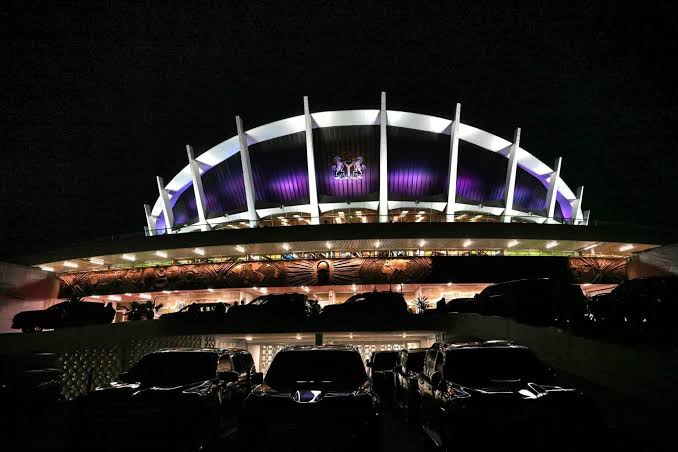
On 1 October 2025, Nigeria’s 65th Independence anniversary, President Bola Tinubu reopened the National Arts Theatre in Iganmu, Lagos. Nearly 50 years after it hosted FESTAC ‘77, the 23,000-square-metre complex, now called the Wole Soyinka Centre for Culture and the Creative Arts, is back in use after a four-year, N68 billion restoration funded by the Central Bank of Nigeria (CBN) and the Bankers’ Committee.
President Muhammadu Buhari began the project, approving a public-private partnership in July 2020. The CBN and the Bankers’ Committee took over management of the estate, while the Federal Government retained ownership. A memorandum of understanding followed in February 2021. Cappa & D’Alberto Limited was appointed main contractor, with Nairda Limited on electrical installations and VACC Limited on mechanical systems. The SANEF committee provided technical oversight. President Tinubu renamed the complex in July 2024 to honour Professor Wole Soyinka, and he commissioned it with Lagos State Governor Babajide Sanwo-Olu, CBN Governor Olayemi Cardoso, Minister of Art, Culture and the Creative Economy Hannatu Musawa, and Professor Soyinka present. He also directed the CBN to set up an endowment fund so the building isn’t left to decay again.
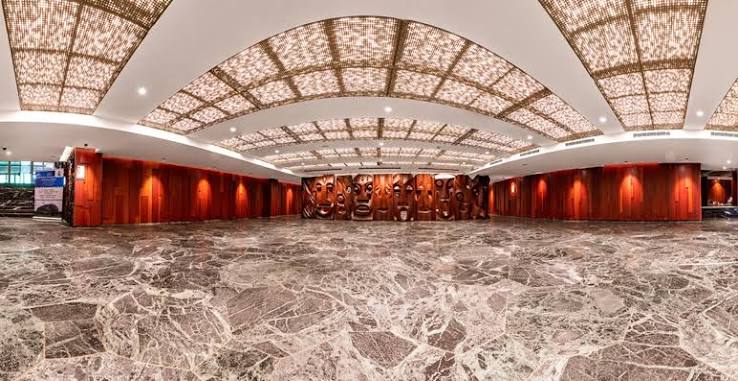
The upgrade goes well beyond cosmetics. The main bowl is an open amphitheatre seating between 4,000 and 5,000 people, with modern audio, video and lighting systems, acoustic engineering and automated stage technology. The banquet hall seats more than 3,000. There are two exhibition galleries, three cinema halls and an African literature library. Behind the scenes, the heating, ventilation and air conditioning systems have been replaced, solar power has been added and fire safety has been upgraded. The complex also has 17 new passenger elevators, new water and sewage networks, more than 300 toilet cubicles, an industrial kitchen, a medical clinic and a fire station. The historical relief artworks on the façade and walls have been restored.
Getting there should also be easier. The Lagos State Government provided extra land and built direct links to the Lagos Blue Line rail network. The wider 44-hectare master plan includes four themed outdoor parks and a Signature Cluster of standalone spaces for music, film, fashion and information technology. Federal officials say full commercial operation will create at least one million jobs.
The theatre has a record to build on. Beyond FESTAC ‘77, it has hosted performers such as Hubert Ogunde and Femi Kuti. Since reopening, the programme has covered a lot of ground. In March 2026, Soyinka joined eleven poets at the ProvidusBank World Poetry Day Café. The centre staged the musical I Wish I Wish: Battle of the Winds for Children’s Day 2026, with a cast of more than 100. Its general manager, Adetola Akerele, described it as the first major performing arts production at the venue since reopening. Nigeria Fintech Week was listed for 22 and 23 September 2026. The Confederation of African Football will hold its 2026 Awards there on 7 December, the first time Lagos has hosted them since January 2015.
That mix is the argument for the venue. Lagos already has established halls, among them the convention centre at Eko Hotel and Suites, the Muson Centre and Terra Kulture. The Wole Soyinka Centre offers something none of them can match: an amphitheatre, a banquet hall, galleries and cinemas on one public site, with rail access and a heritage name that carries weight with international organisers. A conference, a gala and a concert can all run in the same complex. That makes it competitive on scale and on identity, and the pricing and booking terms it sets will decide how competitive it is in practice.
Security is the obvious concern, and it shouldn’t be brushed aside. The neighbourhood around Iganmu has a history of it. A 2021 report by the Foundation for Peace Professionals listed neighbouring Orile Iganmu as a threat to peace in Lagos State, and residents said at the time that official security presence was thin. Organisers weighing a venue, and visitors deciding whether to attend an evening show, will ask what has changed. Assurances won’t answer that. The government’s responsibility goes beyond opening the building. It should keep visible, well-coordinated policing around the complex and its approach roads, and secure the rail link and surrounding streets, especially at night. It should also publish a clear safety plan for event days, which organisers can check and audiences can rely on. The state and federal governments paid for and pushed this restoration, so they should see that people who come to it are safe.
Done properly, the Wole Soyinka Centre can again be a landmark that people choose to visit, and not a building they remember fondly from a better decade.
Discover more from CLARITYNEWSNG
Subscribe to get the latest posts sent to your email.